

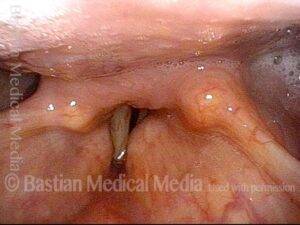
Cervical Osteophyte
Also called bone spurs, osteophytes are usually seen at joints where inflammation or injury causes new bone cells and calcium to be deposited; in other words, new bone is formed. Osteophytes of the cervical spine occur with the passage of time and, when large, can project anteriorly into the swallowing passage. Only rarely do cervical osteophytes alone interfere with a person’s swallowing or voice capabilities.
Cervical Osteophytes do not by Themselves Seem a Major Impediment to Swallowing
Protruding osteophytes (1 of 2)
This 95 year-old man has large cervical osteophytes (bony proliferation due to arthritis). These osteophytes protrude into the pharynx (dotted lines). It would seem they would be a major impediment to swallowing.
Protruding osteophytes (1 of 2)
This 95 year-old man has large cervical osteophytes (bony proliferation due to arthritis). These osteophytes protrude into the pharynx (dotted lines). It would seem they would be a major impediment to swallowing.
Rapid swallowing (2 of 2)
After an initial test swallow, eight boluses of blue applesauce are administered rapidly. The purpose of this is to serve as a “stress test” so that we see his swallowing at its worst…But he has only a small amount of residue, and passes the test. Most individuals with cervical osteophytes are of advanced age. When swallowing is impaired, the explanation is usually more than just the osteophyte.
Rapid swallowing (2 of 2)
After an initial test swallow, eight boluses of blue applesauce are administered rapidly. The purpose of this is to serve as a “stress test” so that we see his swallowing at its worst…But he has only a small amount of residue, and passes the test. Most individuals with cervical osteophytes are of advanced age. When swallowing is impaired, the explanation is usually more than just the osteophyte.
VESS (Videoendoscopic Swallow Study) Findings After Radiotherapy
Narrowed pharyngeal wall (1 of 7)
After radiation and chemotherapy for larynx cancer several years earlier. Note the dry secretions. There is narrowing of the pharyngeal wall (dotted line) due to radiation scarring.
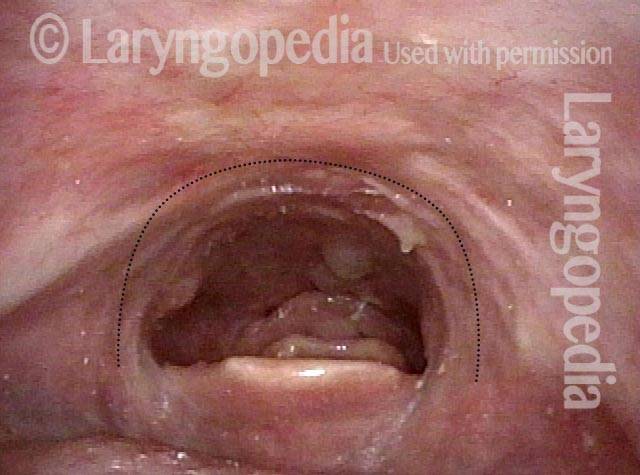
Narrowed pharyngeal wall (1 of 7)
After radiation and chemotherapy for larynx cancer several years earlier. Note the dry secretions. There is narrowing of the pharyngeal wall (dotted line) due to radiation scarring.
Swallowing applesauce (2 of 7)
After the second bolus of blue-stained applesauce. The propulsive ability (“pitcher of swallowing”) is inadequate, leaving a lot of post-swallow residue.
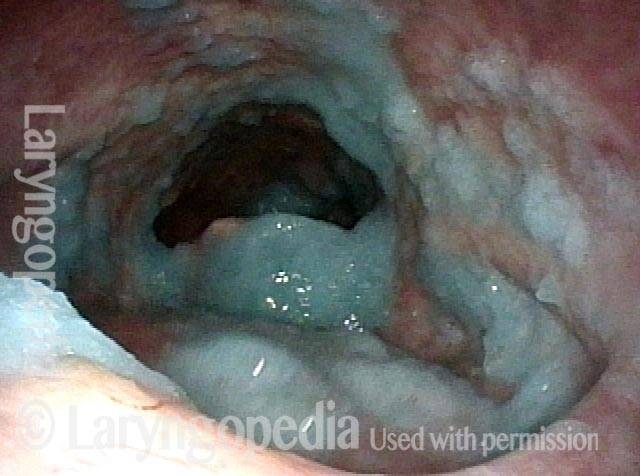
Swallowing applesauce (2 of 7)
After the second bolus of blue-stained applesauce. The propulsive ability (“pitcher of swallowing”) is inadequate, leaving a lot of post-swallow residue.
After sipping water (3 of 7)
After three sips of blue-stained water, much of the applesauce has been washed away.
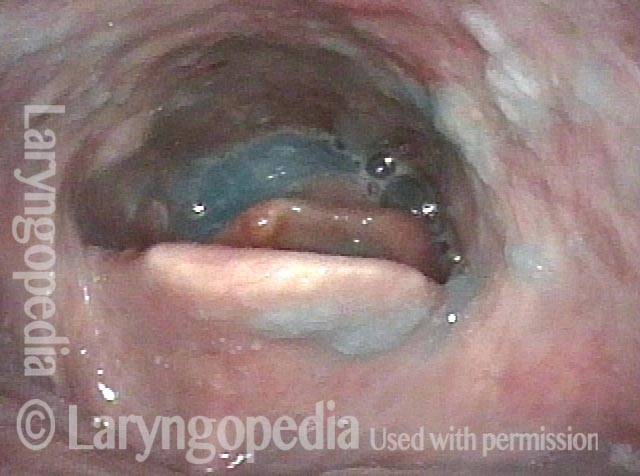
After sipping water (3 of 7)
After three sips of blue-stained water, much of the applesauce has been washed away.
Gravity aiding in swallowing (4 of 7)
Additional water washes nearly all of the residue in the “swallowing crescent” away–mostly by gravity as seen in the next photo.
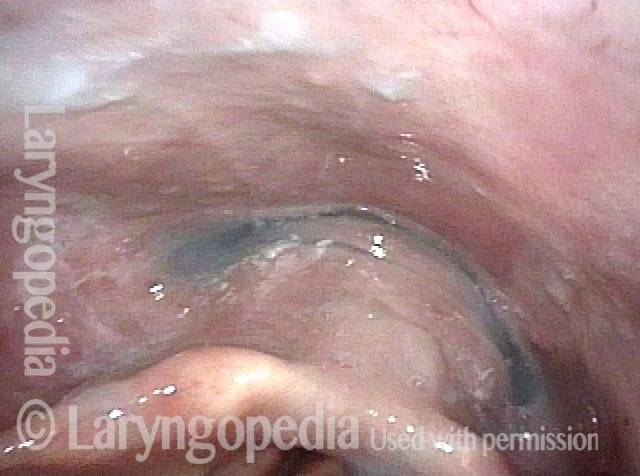
Gravity aiding in swallowing (4 of 7)
Additional water washes nearly all of the residue in the “swallowing crescent” away–mostly by gravity as seen in the next photo.
Lifting larynx (5 of 7)
Each swallow looks like this. The pharynx “bird swallow” mechanism lifts larynx forward so that the swallowing crescent opens down to the cricopharyngeus muscle, indicated by double dotted lines. (PC = post-cricoid.)
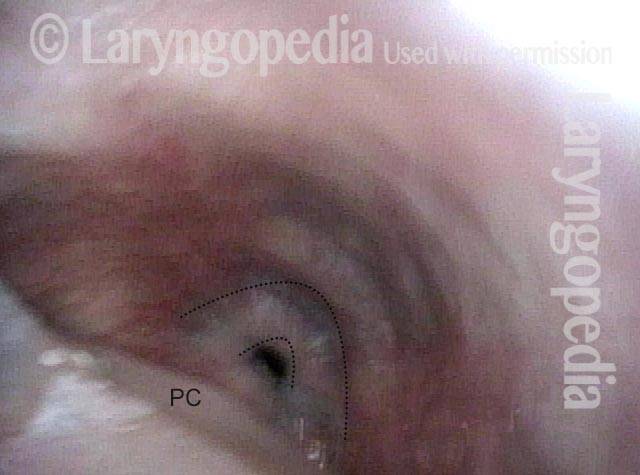
Lifting larynx (5 of 7)
Each swallow looks like this. The pharynx “bird swallow” mechanism lifts larynx forward so that the swallowing crescent opens down to the cricopharyngeus muscle, indicated by double dotted lines. (PC = post-cricoid.)
A closer look (6 of 7)
At closer range, the cricopharyngeus muscle bulge is seen more clearly, along with the small opening into the esophagus.
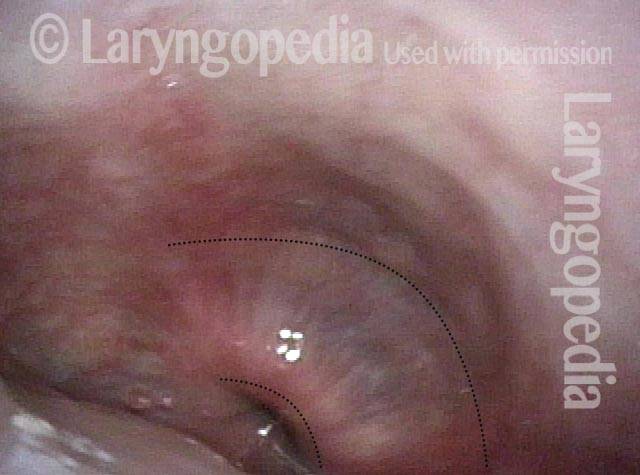
A closer look (6 of 7)
At closer range, the cricopharyngeus muscle bulge is seen more clearly, along with the small opening into the esophagus.
Gravity aiding again in swallowing (7 of 7)
Blue-stained water flowing into the esophagus mostly by gravity.
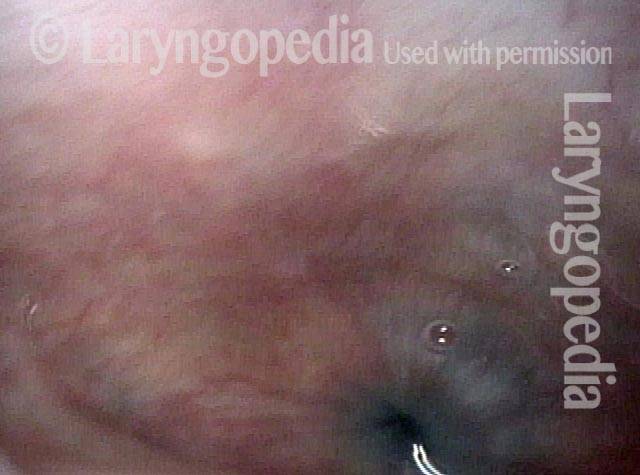
Gravity aiding again in swallowing (7 of 7)
Blue-stained water flowing into the esophagus mostly by gravity.
Tagged Disorders, Photos, Swallowing Disorders