

An encyclopedia about voice, swallowing, airway, coughing, & other head + neck disorders.

Laryngomalacia

Larngomalacia is an abnormal laxity or softening of laryngeal tissues, most often seen during inspiration as floppiness and indrawing of the arytenoid mucosa or aryepiglottic cords. Sometimes the epiglottis acts like a sail and, caught by the inspiratory air, flips downward to partially cover the laryngeal vestibule.

Laryngomalacia may be the result of structural weakness, especially in premature infants; it can also be “induced” or “allowed” in older children and adults of all ages, as one type of nonorganic breathing disorder.

Laryngomalacia Due to Breathing Tube Injury

Visual Portfolio, Posts & Image Gallery for WordPress

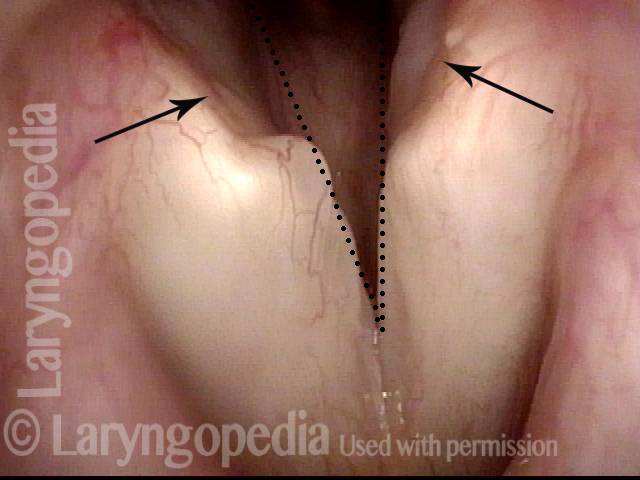
Breathing tube injury (1 of 4)

After a life-threatening illness including weeks in an ICU on a ventilator (breathing tube involved), this person underwent tracheotomy. Here, the old breathing tube injury of the vocal cords is clearly seen and explains a very hoarse voice. Arrows point out divots of tissue loss from pressure necrosis. Dotted lines indicate where the margins of the vocal cords would be if uninjured.
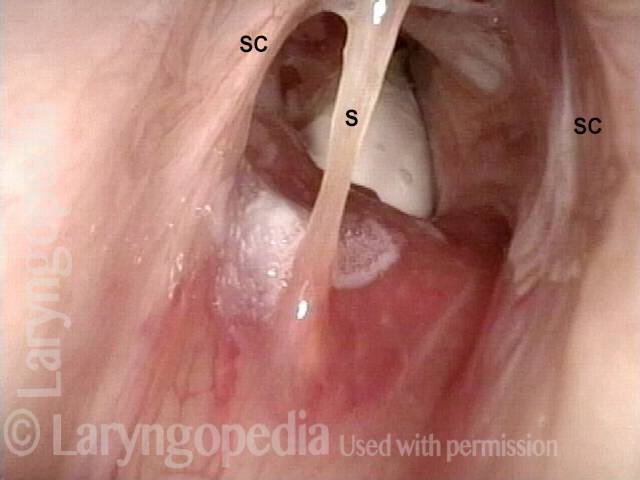
Synechia and lateral scarring (2 of 4)

Viewing from barely below the vocal cords, the white tracheotomy tube enters the airway in the distance, and a synechia (s) and lateral scarring (sc) are seen in the foreground.
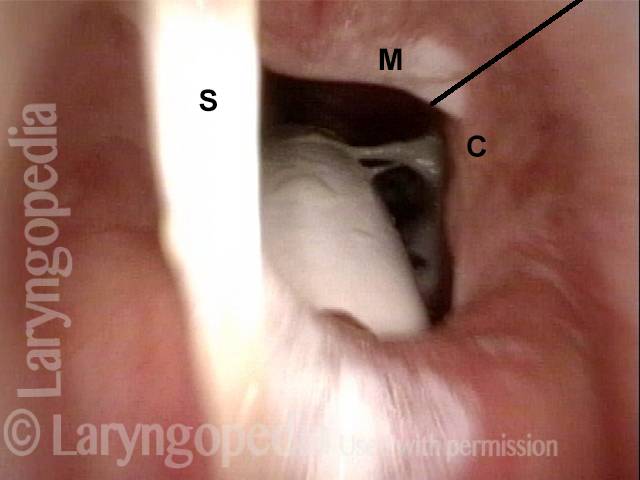
Damage from tracheotomy tube (3 of 4)

Viewing from deeper into the subglottis while the patient exhales with trach tube plugged, there is “blow-by” dark room around the #6 tracheotomy tube. The diagonal line, upper right, indicates junction between membranous (M) and cartilaginous (C) trachea.
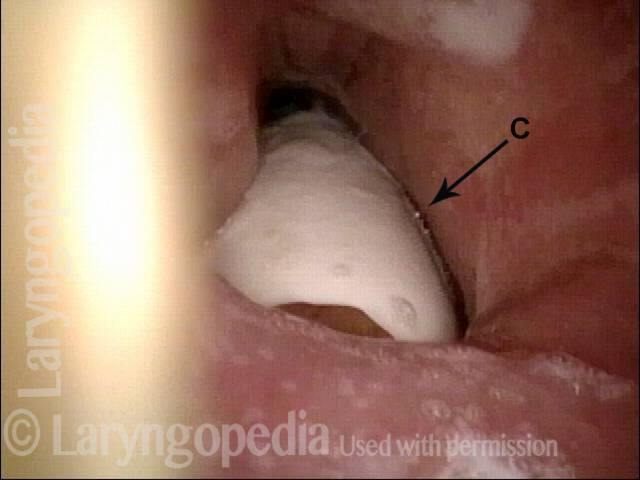
Indrawing of the cartilaginous wall (4 of 4)

When she inhales with tracheotomy tube plugged, the walls of the trachea collapse inward, and the patient cannot fill her lungs. Most noteworthy is the indrawing of the cartilaginous wall (arrow at C). Tracheal narrowing for exhalation can be managed with expiratory straw breathing. Collapse of this magnitude during inspiration implies the need for repair (resection of the bad segment and re-anastomosis).
Resources for Further Reading

Lane RW, Weider DJ, Steinem C, Marin-Padilla M. Laryngomalacia: A Review and Case Report of Surgical Treatment With Resolution of Pectus Excavatum. 1984;110(8):546-551. doi:10.1001/archotol.1984.00800340058017

Jani P, Koltai PJ, Ochi JW, Bailey CM. Surgical treatment of laryngomalacia. 1991;105(12):1040-1045. doi:10.1017/s0022215100118158

Richter GT, Rutter MJ, deAlarcon A, Orvidas LJ, Thompson DM. Late-Onset Laryngomalacia. Archives of Otolaryngology–Head & Neck Surgery. 2008;134(1):75. doi:10.1001/archoto.2007.17

Scott BL, Lam D, MacArthur C. Laryngomalacia and Swallow Dysfunction. Ear, Nose & Throat Journal. 2019;98(10):613-616. doi:10.1177/0145561319847459

Fabrizio Cialente, Meucci D, Tropiano ML, et al. Changes in Breathing Patterns after Surgery in Severe Laryngomalacia. Children. 2021;8(12):1120-1120. doi:10.3390/children8121120

Pinto JA, Wambier H, Mizoguchi EI, Gomes LM, Kohler R, Ribeiro RC. Surgical treatment of severe laryngomalacia: a retrospective study of 11 cases. Brazilian Journal of Otorhinolaryngology. 2013;79:564-568. doi:10.5935/1808-8694.20130101

Isaac A, Zhang H, Soon SR, Campbell S, El-Hakim H. A systematic review of the evidence on spontaneous resolution of laryngomalacia and its symptoms. International Journal of Pediatric Otorhinolaryngology. 2016;83:78-83. doi:10.1016/j.ijporl.2016.01.028

Mills JF, Monaghan NP, Nguyen SA, O’Rourke AK, Halstead LA, Meyer TA. Adult Laryngomalacia: A Scoping Review. Otolaryngology–head and neck surgery: official journal of American Academy of Otolaryngology-Head and Neck Surgery. 2024;170(4):1020-1031. doi:10.1002/ohn.639

Irace AL, Dombrowski ND, Kawai K, et al. Evaluation of Aspiration in Infants With Laryngomalacia and Recurrent Respiratory and Feeding Difficulties. JAMA Otolaryngology–Head & Neck Surgery. 2019;145(2):146. doi:10.1001/jamaoto.2018.3642


Share this article

Support Laryngopedia
Are you a patient or doctor who loves Laryngopedia? If we've helped you, help us help others too!