
An encyclopedia about voice, swallowing, airway, coughing, & other head + neck disorders.

Cryptococcus Neoformans

Cryptococcus of the larynx is a fungal infection of the larynx caused most commonly by Cryptococcus neoformans and sometimes Cryptococcus gattii. Compared with more common histoplasmosis and even blastomycosis, this is a truly rare disease that is estimated to affect fewer than 1 per 100,000 people in Illinois.

Usually, this fungal disease involves the lung or central nervous system in severely immunocompromised individuals, but it can present as an uncommon localized form of cryptococcal infection affecting the larynx.

It is most often seen in immunocompromised people such as those with HIV/AIDS, transplant patients, etc. It can be seen, however, in immunocompetent people, especially (but still rarely) in those using inhaled corticosteroids on a chronic basis. Though a source of the organisms can be the dust from the droppings of birds, especially pigeons, the disease is even rare in pigeon keepers.

Symptoms

The presentation is most commonly with persistent hoarseness or a nagging sore throat.

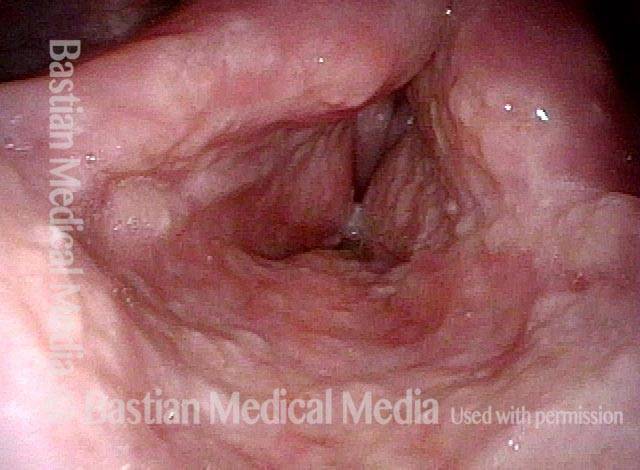
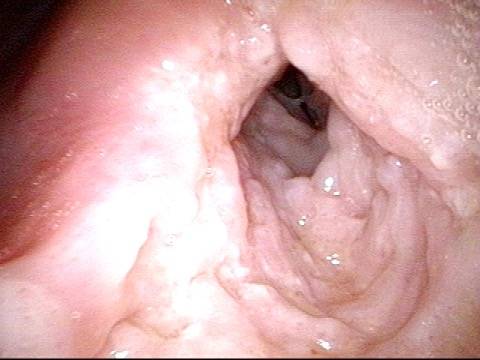
Careful laryngeal examination shows a bumpy, granular appearance, such as seen in the example below. It can mimic laryngeal cancer at first appearance, but biopsy specimens stained with India Ink or mucicarmine instead shows encapsulated yeast and inflammatory/granulation tissue. If organisms are occult, “granulation” is the usual description. Culture of the organism can be attempted, but takes some weeks to get results.

Treatment

Treatment is with antifungal medication such as fluconazole, itraconazole, etc. Severe cases may require amphotericin B. Prognosis is generally good, assuming the patient is not severely immunocompromised.

Cryptococcus Infection of the Larynx

Visual Portfolio, Posts & Image Gallery for WordPress

Panoramic view (1 of 6)

Panoramic view of laryngeal vestibule in a man with very longstanding hoarseness and sore throat. Note intense redness and bumpy mucosal surface. Biopsy revealed Cryptococcus neoformans.
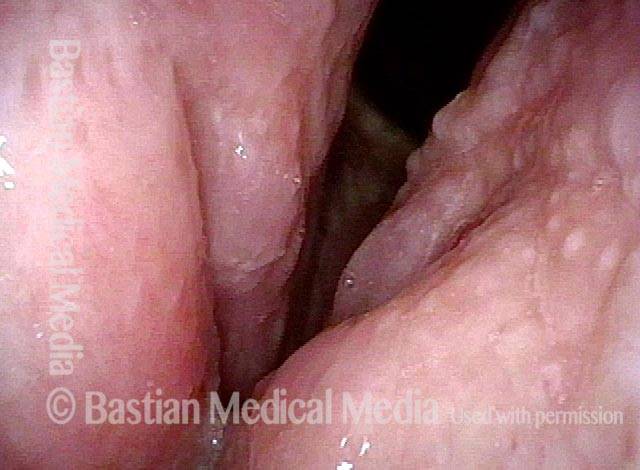
Closer view (2 of 6)

Closer view of the vocal cords shows similar intense inflammation and rough surface.
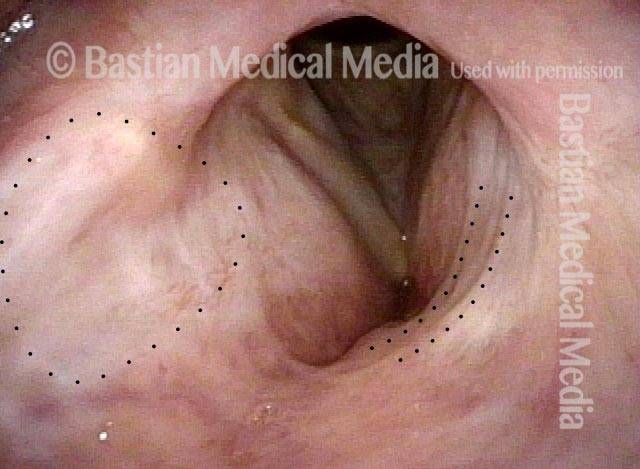
One year later (3 of 6)

After a one-year course of fluconazole, an oral anti-fungal medication. Symptoms are gone. The larynx is no longer inflamed, and the mucosal surface is smooth. White area of scarring (dotted surround), and scar band (parallel dotted lines).
One year later, close-up (4 of 6)

Close-up of the vocal cords shows similar resolution of redness and cobblestoned surface.

4 years later (5 of 6)

The patient has been lost to followup and re-presented with increased hoarseness and sore throat. Here, we see what appears to be recrudescence of the infection with granularity throughout the laryngeal vestibule.
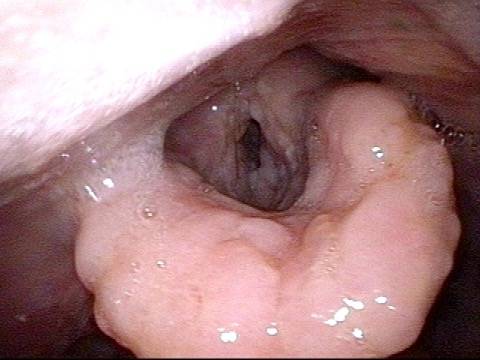
Fungal re-growth (6 of 6)

At closer range, note the granularity of laryngeal petiole and false vocal cords. The vocal cords are in the distance, but also involved by the fungal re-growth.
Resources for Further Reading

Nadrous HF, Ryu JH, Lewis JE, Sabri AN. Cryptococcal laryngitis: case report and review of the literature. The Annals of Otology, Rhinology, and Laryngology. 2004;113(2):121-123. doi:10.1177/000348940411300207

Kerschner JE, Ridley MB, Greene JN. Laryngeal Cryptococcus: Treatment With Oral Fluconazole. Archives of Otolaryngology-head & Neck Surgery. 1995;121(10):1193-1195. doi:10.1001/archotol.1995.01890100097017

Mittal N, Collignon P, Pham T, Robbie M. Cryptococcal infection of the larynx: case report. The Journal of Laryngology & Otology. 2013;127(S2):S54-S56. doi:10.1017/S0022215113000522

Jeng JY, Tomblinson CM, Ocal IT, Vikram HR, Lott DG. Laryngeal cryptococcosis: Literature review and guidelines for laser ablation of fungal lesions. The Laryngoscope. 2015;126(7):1625-1629. doi:10.1002/lary.25749

Worrall DM, Lerner DK, Naunheim MR, Woo P. Laryngeal Cryptococcosis: An Evolving Rare Clinical Entity. Annals of Otology Rhinology & Laryngology. 2019;128(5):472-479. doi:10.1177/0003489419826131