


Photo Essay

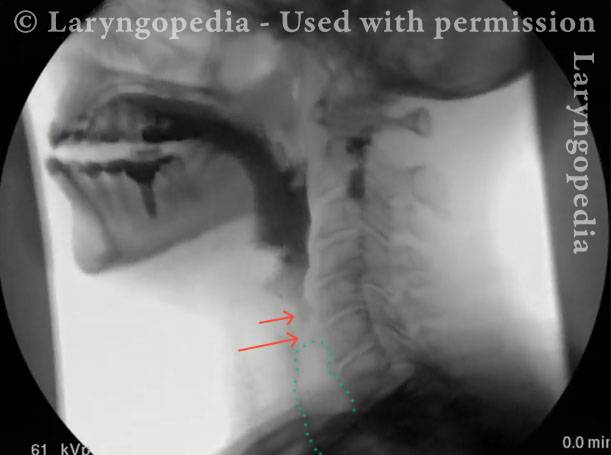
X-Ray of Dilating Air (1 of 4)
During the pharyngeal phase of swallowing, barium is just reaching the cricopharyngeal (upper esophageal) sphincter. Above the sphincter is the head of the barium bolus (short arrow). The sphincter is in the area of the longer arrow. Note the large amount of air dilating the cervical esophagus that is about to “receive” the barium (dotted line).
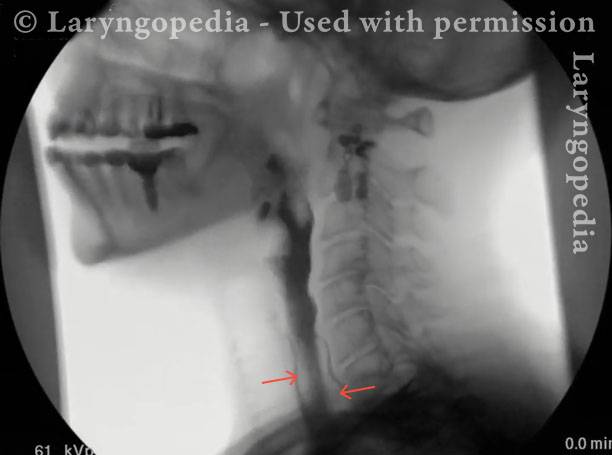
Retained Air in Larynx (2 of 4)
Note here that the barium stream is coursing through a cervical esophagus distended with air both anterior and posterior to the barium (arrows). Due to a prior swallow, the outline of the retained air is “marked” with a thin line of barium.
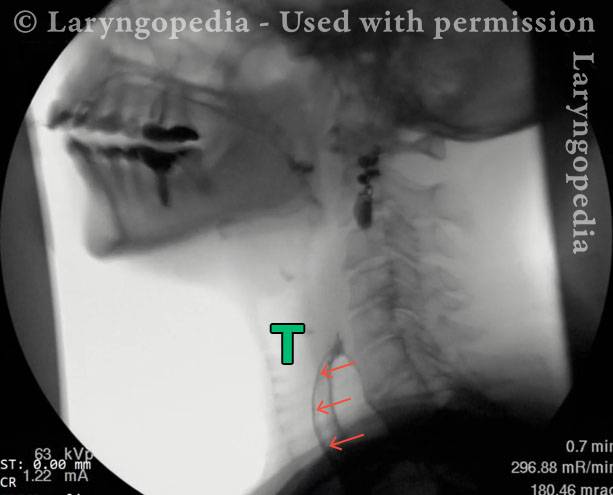
Esophagus bulges anteriorly (3 of 4)
After a different swallow of barium, there is a brief moment when air is pushed upwards for a desired (but impossible) burp. At this moment, the dilation of the esophagus bulges anteriorly as if to escape around the non-compressible trachea (T).
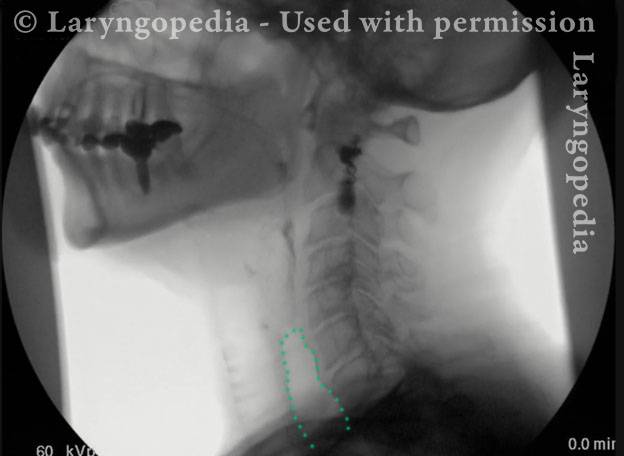
Air remains after swallow (4 of 4)
After the swallow is complete, the “pillow” or “sausage” of air remains in the upper esophagus, indicated by the dotted line.
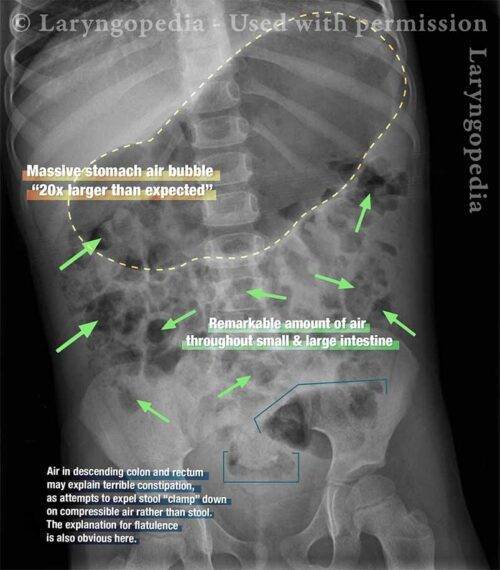
Children with R-CPD Need Champions
This four-year-old is an example of the many young children who fulfill the criteria for a diagnosis of R-CPD, but who cannot find a doctor to help. Her parents also say the following: “She was impossible to burp as an infant. She only eats small amounts, stopping due to discomfort, and is falling behind developmental markers (especially weight). Her abdomen blows up like a balloon each day. She requires daily laxative use, and passes a long stream of flatulence before moving her bowels.”This child precociously describes what is clearly throat nausea, and speaks of trouble breathing and too much “throat water.” When she has hiccups (once a week or so), they hurt a lot.For her age, this child has undergone significant testing and dietary manipulations, even medications, without any significant benefit. The friction and delay in the medical system of this family’s large city is so great, and the child’s (and her parents’) distress so intense that they are traveling hundreds of miles for the care of a physician who will treat expeditiously based upon the syndrome alone.